
Key Use Cases
How a National Security Provider Automated Shift Confirmations Across Mixed Time Zones
Sector: Physical Security and Guarding, Australia
Profile: A national australian security provider operating control rooms across multiple regions and time zones.
Operational calling volume: Automated shift confirmation calling, placed one hour before each shift and written back to the provider's source-of-truth system.
The Challenge
Before each shift, the provider needed to confirm that the rostered guard was attending. Done manually, this meant an operator working out when each shift started, calling the guard ahead of time, and updating the roster with the answer, one guard at a time.
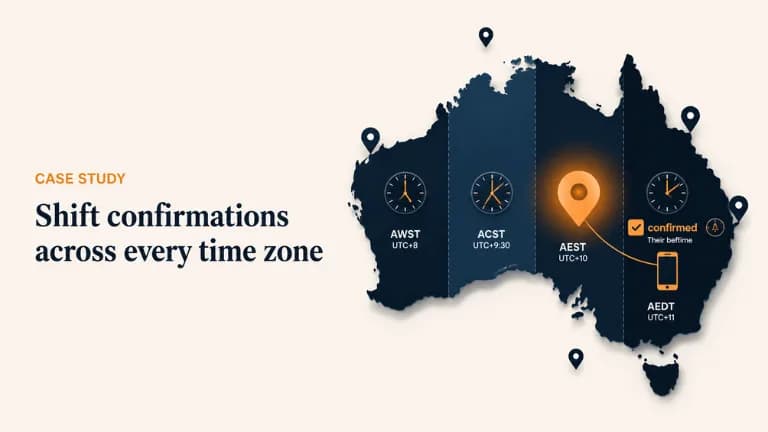
The timing was the hard part. Shift start times and time zones in the scheduling data were inconsistent and mixed together, so working out exactly when each confirmation call should go out was error-prone by hand. A call placed too early or against the wrong time zone is worse than no call, and a missed confirmation meant the control room only discovered a no-show once the shift had already started, with no time to arrange a replacement.
The Solution
The provider deployed Callease to automate shift confirmation calling end to end. Callease reads the shift data from the provider's source-of-truth system, resolves the correct local start time for each shift despite the mixed time zones, and schedules a confirmation call to go out one hour before each shift begins.
At the scheduled time, Callease calls the guard in natural spoken language, confirms whether they are attending, and writes the result straight back into the source-of-truth system. The control room sees each shift move to confirmed or not attending automatically, an hour ahead, with no manual dialling or data entry.
Implementation
The workflow runs entirely off the provider's existing scheduling data, with no separate setup per shift.
Because the entire workflow reads from and writes back to the one system, the control room manages it from the tool they already use, and Callease handles the timing, the calling, and the update.
- Reads from the source of truth. Callease takes the shift roster, start times, and time zones directly from the provider's scheduling system, so there is no double entry.
- Normalises mixed time zones. The system resolves each shift's correct local start time from inconsistent, mixed-time-zone data, so the call timing is right regardless of how the source data is entered.
- Times the call to one hour before the shift. For every shift, Callease calculates the correct moment and schedules the confirmation call to go out an hour ahead of the start time.
- Confirms and writes back. Callease places the call, captures whether the guard is attending, and updates the confirmed or declined status in the source-of-truth system automatically.
Results
- Confirmation calls are timed correctly across every time zone. The system resolves mixed and inconsistent shift data on its own, so calls go out at the right local time without manual checking.
- Every rostered shift is confirmed an hour ahead. The control room knows before the shift starts whether the guard is attending, rather than discovering a gap once it has already begun.
- No-shows surface with time to act. A declined or unanswered confirmation gives the control room advance notice to arrange a replacement before the shift starts.
- Status updates itself in the source of truth. Confirmed and declined outcomes are written back automatically, removing manual roster updates and keeping the record current.
- Operators are freed from routine confirmation work. The calling, timing, and updating run on their own, so operator attention stays on live coordination.
Why it works?
Shift confirmation is repetitive, time-sensitive, and dependent on getting the timing exactly right. Callease handles all three: it reads the roster, resolves the correct time, places the call, and updates the outcome, reliably and at scale. The provider gains dependable advance confirmation and a current, accurate roster, without adding control-room workload.