
Key Use Cases
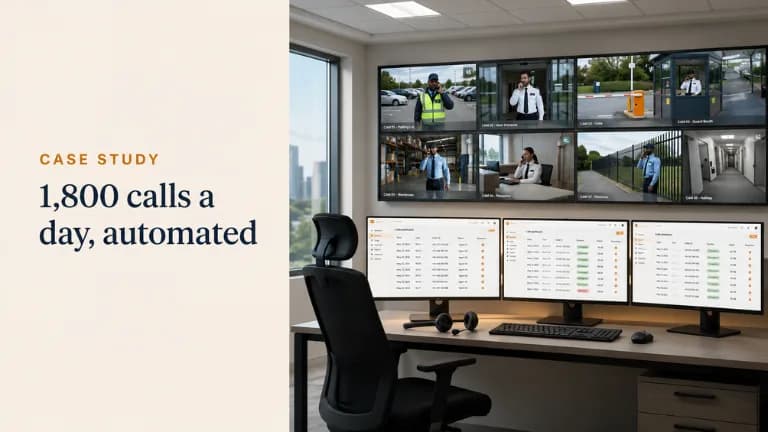
How a National Security Provider Automated 1,800 Control-Room Calls a Day
Sector: Physical Security and Guarding, Australia.
Profile: A national australian security provider operating control rooms that monitor guards working alone across client sites.
Operational calling volume: Around 1,800 operational calls placed automatically each day across welfare and patrol workflows.
The Challenge
The provider's control rooms ran their operational calling by hand. Operators worked down rosters placing welfare and check-in calls one at a time, while also managing alarms, radio traffic, and live incidents. As the operation grew across more sites and shifts, keeping every scheduled call on time became harder, records of what was called and when were inconsistent, and escalation of a missed response depended on an operator noticing it during a busy shift. The routine calling load consumed operator time that was needed for live judgment and response.
The Solution
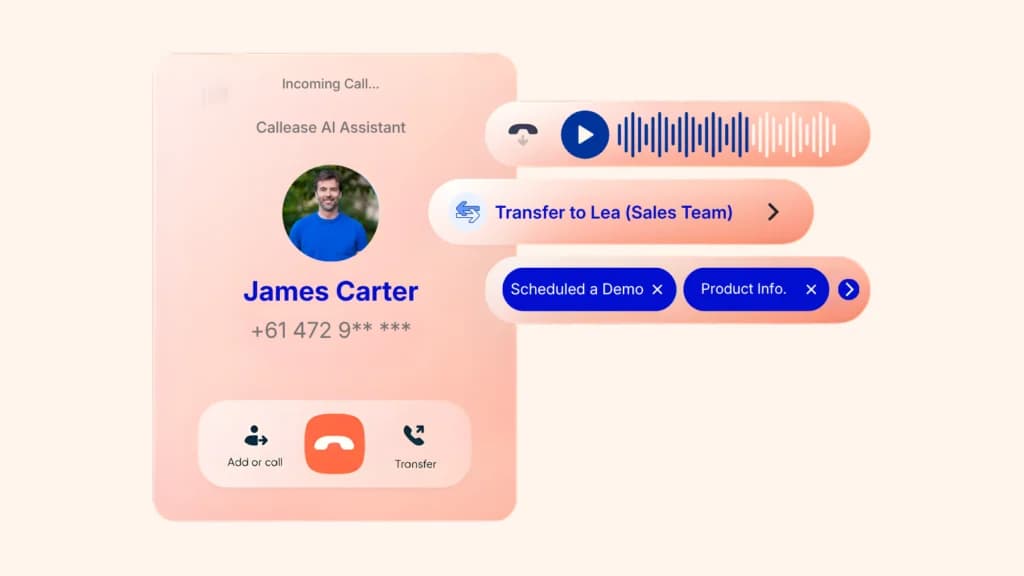
The provider deployed Callease to automate the routine operational calling across its control rooms. The platform places each call in natural spoken language, confirms the response, records the outcome, and escalates exceptions automatically. Its deterministic engine keeps every call inside defined rules, so behaviour stays consistent across every call, shift, and site, and each call produces a clean, structured record as a by-product of how it runs.
Two workflows carry the volume:
- Welfare and check-in calls. Around 1,000 calls a day, placed at set welfare intervals through each shift.
- Patrol and post reminders. Around 800 calls a day, delivered consistently across sites without manual dialling.
Implementation
Callease integrates directly with the provider's scheduling system, which acts as their single source of truth. The result is a set-once, run-all-week model with no double entry.
Because rosters, intervals, and escalation contacts all live in one system, the provider manages the entire operation from the tool they already use, and Callease executes against it.
- Weekly rostering, scheduled once. The provider schedules a full week of rosters in their existing system, and Callease reads from it directly, so welfare calls run against the live roster without separate setup.
- Automatic welfare intervals. Callease places welfare calls at the configured intervals across the shift, recurring automatically for the length of each roster.
- Automatic retries. For any guard who does not answer, Callease schedules retries on its own, so a missed pickup is followed up without an operator having to notice and redial.
- Escalation routing from the source of truth. If an incident is reported during a call, Callease transfers it to the designated contact immediately, with the routing and escalation numbers defined in the same source-of-truth system.
Results
- Around 1,800 operational calls a day now run automatically. Work that operators previously placed by hand is handled end to end by the platform.
- Every scheduled welfare check is placed on time. Set intervals and automatic retries mean coverage no longer depends on how busy the shift is.
- Escalations route on their own. A reported incident transfers straight to the right contact, rather than waiting on an operator to catch and act on it.
- Every call leaves a clean record. Each interaction is captured consistently, giving the provider a complete account across sites and shifts.
- Operators are freed for live work. With routine calling automated, operator attention concentrates on incidents, exceptions, and response.
Why it works?
The routine, rule-bound calling now runs reliably on its own, and operators concentrate on judgment, exceptions, and response. The provider gains consistency and a complete record on high-volume operational calling, without adding headcount to the control room.